Demand to Break Pakistan Into 16 Units Sparks Political and Security Concerns (Open Ai)
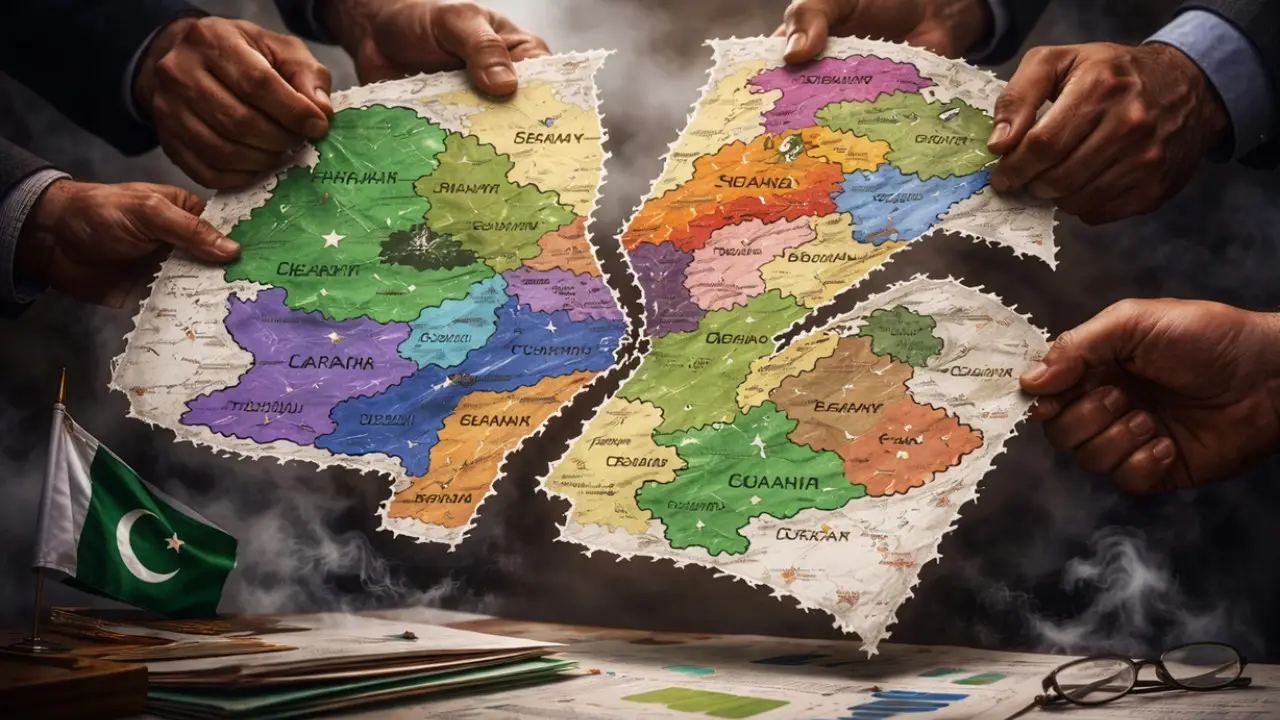
Islamabad: In Pakistan, a big political demand to divide the country into smaller parts has become the subject of the latest debate. Abdul Aleem Khan, Pakistan's federal communications minister and chairman of the Istehkaam-e-Pakistan Party (IPP), has proposed that the country's existing four provinces—Punjab, Sindh, Balochistan, and Khyber Pakhtunkhwa (KP)—be divided into three parts. If this plan is implemented, a total of 12 to 16 administrative provinces can be formed in Pakistan. This proposal has triggered extensive discussions at political, social, and security levels.
Abdul Aleem Khan argues that the existing provinces of the country are very large, due to which governance and government services are not reaching remote parts smoothly. Creating small provinces will provide better administration and facilities to the local people, he says.
According to the proposal, Punjab, Sindh, Balochistan, and KP can be divided into three parts each. For example, Punjab will be divided into North, Central, and South Punjab. Similarly, small administrative areas will be formed in other provinces also.
Some major political parties and regional organizations are supporting this scheme. Parties like IPP and MQM-P want to press for new provinces through the 28th Constitutional Amendment. On the other hand, the Pakistan People's Party (PPP) and Sindh Chief Minister Murad Ali Shah are against this proposal and have warned not to accept dividing their province. Nationalist organizations of Balochistan and KP are also describing the partition as endangering their identity.
According to political and administrative experts, merely increasing the number of provinces in Pakistan will not solve the problem. Former police chief Syed Akhtar Ali Shah says the root of the problem lies in institutional weaknesses and lack of accountability, not the number of provinces. In such a situation, creating new provinces without basic reforms can increase anarchy.
There are already voices of separatism and autonomy in Balochistan and KP. These areas further intensify the questions related to administrative division. Analysts say such partition moves could challenge local identity, cultural diversity, and political stability.
If the proposal is implemented, it will be a major change in the administrative map in Pakistan and will impact not only the governance level but also the social and political equations. The formation of new provinces may raise issues of power distribution, resource allocation, and local identity.
The demand for such provincial division in Pakistan makes it clear that there is a desire for serious change in the political and administrative realities there. However, it is not easy to implement and requires in-depth study of the social, cultural, and political implications associated with it.



Copyright © 2026 Top Indian News